

From One-Offs to Campaigns: Getting More From Every Content Idea
Monday, October 19, 2026
Most content doesn’t underperform because it is low quality. It underperforms because it is used once.
Teams invest time and budget into a strong piece of content. It launches, performs for a short window, and then disappears while the team moves on to the next request.

The problem is not what is created. It is how little value is extracted from it. Most teams do not need more ideas. They need to get more mileage from the ones they already have.
This article breaks down why content gets treated as one-off output, what a real content campaign looks like, and how teams can turn a single idea into sustained, multi-channel impact.
Quick Summary
• The real issue: content underperforms when it is treated as a one-off deliverable instead of part of a planned content campaign strategy.
• What happens: teams launch strong assets, then move on, leaving value on the table and forcing themselves to start from zero.
• What campaign thinking changes: one core idea is planned to extend across formats, channels, and time as part of a scalable content system.
• The outcome: more consistent messaging, better ROI from each asset, and less pressure to constantly generate new ideas.
The One-Off Trap
On paper, content production looks clean and contained. A need is identified. A piece is created. It launches.
In practice, that structure limits how much value a team gets from its work. A single asset carries the weight of the idea. Once it ships, the idea effectively expires.
The pattern is familiar:
• A strong asset is developed for a launch
• The team focuses on delivering it under deadline
• It goes live and performs for a short period
• Attention shifts immediately to the next request
There is rarely a clear plan for what happens after launch. Over time, this creates a cycle where teams are constantly producing but rarely compounding value.
What “Campaigns, Not One-Offs” Actually Means
Campaign thinking is not about producing more content.
It is about designing content so a single idea can operate across multiple formats, channels, and timeframes.
Instead of asking:
“What do we need to create?”
Teams start with:
“What is the core idea, and how far can it go?”
In brand campaigns, a single message often anchors everything while execution shifts by audience and channel. The same principle applies in B2B environments. The difference is how intentionally it is applied.
In practice, a content campaign is a coordinated effort built around a central message and distributed across multiple channels over time.
At its simplest, a content campaign strategy answers one question: How will one idea be developed, distributed, and extended over time?

Where Content Breaks in the Real World
For most in-house teams, the issue is not strategy. It is structure. A campaign is treated as a launch moment instead of a system.
What that looks like:
• A strong “hero” asset is created for a launch
• The team rallies to deliver it
• After launch, there is no clear ownership of extending the idea
• The content calendar returns to business-as-usual
• The same idea is rebuilt months later
Each time this happens, value is lost. The content lifecycle keeps restarting instead of compounding.
This is not a workflow problem. It is an idea utilization problem.
A Real Example: From One Story to a Campaign System
One of the clearest patterns we have seen comes from work with an insurance client.
As Peter Shannon, President of Memory Tree, explains:
“We went coast to coast capturing real stories from people who had experienced floods, fires, and accidents. It started as one video, one story, but quickly became much more than that.”
That original piece became the foundation for a broader campaign. Instead of treating the video as a finished deliverable, the team treated it as a starting point for ongoing content:
• A feature story used in marketing
• Multiple short-form social cuts created from the same footage
• Variations tailored for different audiences and channels
• Content reused across campaigns over time
“The real value wasn’t just the original piece,” he says. “It was everything that came after. That one story turned into a campaign content library we could use for years.”

This is how teams repurpose content across channels without rebuilding from scratch. What started as one piece became a repeatable campaign model.
The key difference was not the format. It was the intent. The content was built to last.
What Campaign Thinking Looks Like in Practice
Campaign thinking becomes clearer when broken into components.
A Core Idea
A single narrative that carries across formats.
It defines the message, audience, and purpose the campaign is built around.
Planned Phases
Pre-launch, launch, and post-launch are defined upfront.
Each phase has its own assets, channels, and goals.
An Asset Stack
A single idea produces multiple outputs:
• Long-form content
• Short-form derivatives
• Supporting assets
This is a content reuse and atomization model: build once, extend many times.
Multi-Channel Distribution
Content is designed for where it will live from the jump. The same idea is adapted for social, web, email, and sales enablement. It becomes a simple multi-channel content strategy built around one core idea.

Ongoing Use
The idea is extended, not replaced. Launch is treated as the midpoint of a campaign, not the endpoint.
Where a Content Partner Fits
For many teams, the challenge is not understanding this model. It is executing it.
This starts by reframing the brief: considering not just “what asset is needed,” but “what campaign does this asset belong to, and what else should be captured or created at the same time.”
Campaign thinking requires planning beyond a single deliverable, capturing additional assets during production, designing for reuse, and maintaining consistency over time. It also requires someone owning what happens after launch.
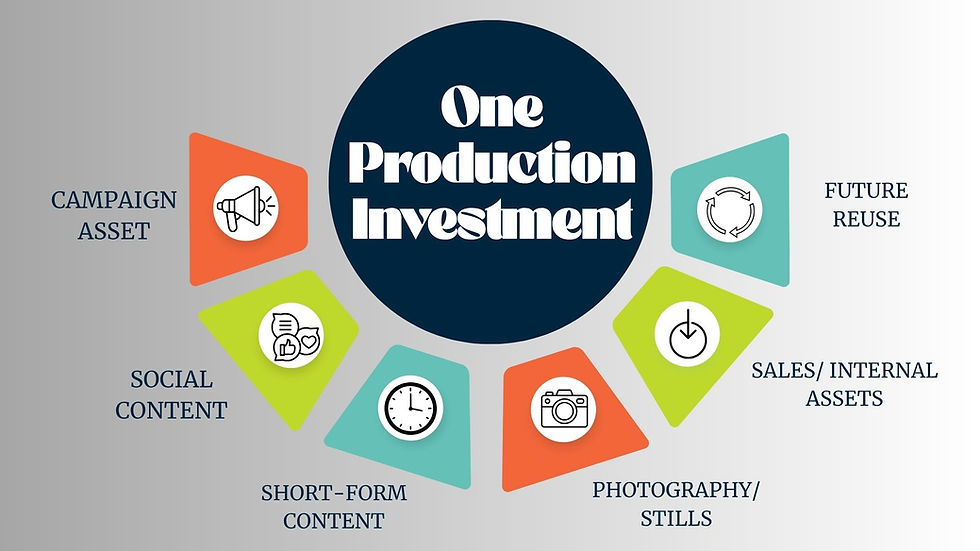
This is where a content operations partner can help structure the work: turning single-asset briefs into campaign content roadmaps, planning the asset stack, and running ongoing extensions so campaigns do not break down under real-world pressure.
From One-Off Output to Compounding Value
The difference is not effort. It is structure.
In a one-off model:
• Ideas are used once
• Content resets constantly
The content lifecycle is short and resets with every new request.
In a campaign model:
• Ideas extend
• Content builds over time
This is the shift from isolated production to an integrated content campaign strategy.
What to Change First
You do not need to rebuild everything. Start small:
• Define the core idea before the asset
• Plan at least one extension before production
• Identify reuse opportunities across channels
• Plan how the content will be repurposed across channels before production begins
• Decide who owns the long-tail of each idea
• Treat launch as the midpoint, not the endpoint
Final Thought
When content is designed to extend, it compounds instead of resets.
That is what effective content marketing campaigns and content systems do.
Where to Start
If your team feels like it is constantly starting from zero, look at how your ideas are being used:
• Where does the idea stop?
• What happens after launch?
• What could be reused but is not?
Those answers will show whether you are producing content or building campaigns.
If you are trying to move from one-off execution to a more sustainable model, start by building around your strongest ideas and designing them to extend across formats, channels, and time. To see how this works in practice, Memory Tree can walk you through how teams structure campaigns around a single idea and where to find the biggest gains with your assets.

Comments